
Four Trade-offs in Decorating Haircare Bottles, Priced Honestly
Every decoration decision on a haircare bottle buys one thing and pays for another. Full-wrap colour buys shelf presence and costs recyclability. Foil buys a premium finish and costs flexibility on curved plastic. A longer run buys a lower unit price and costs warehouse space. Naming the trade-off before the artwork is frozen is what keeps a launch from being renegotiated at the printer.
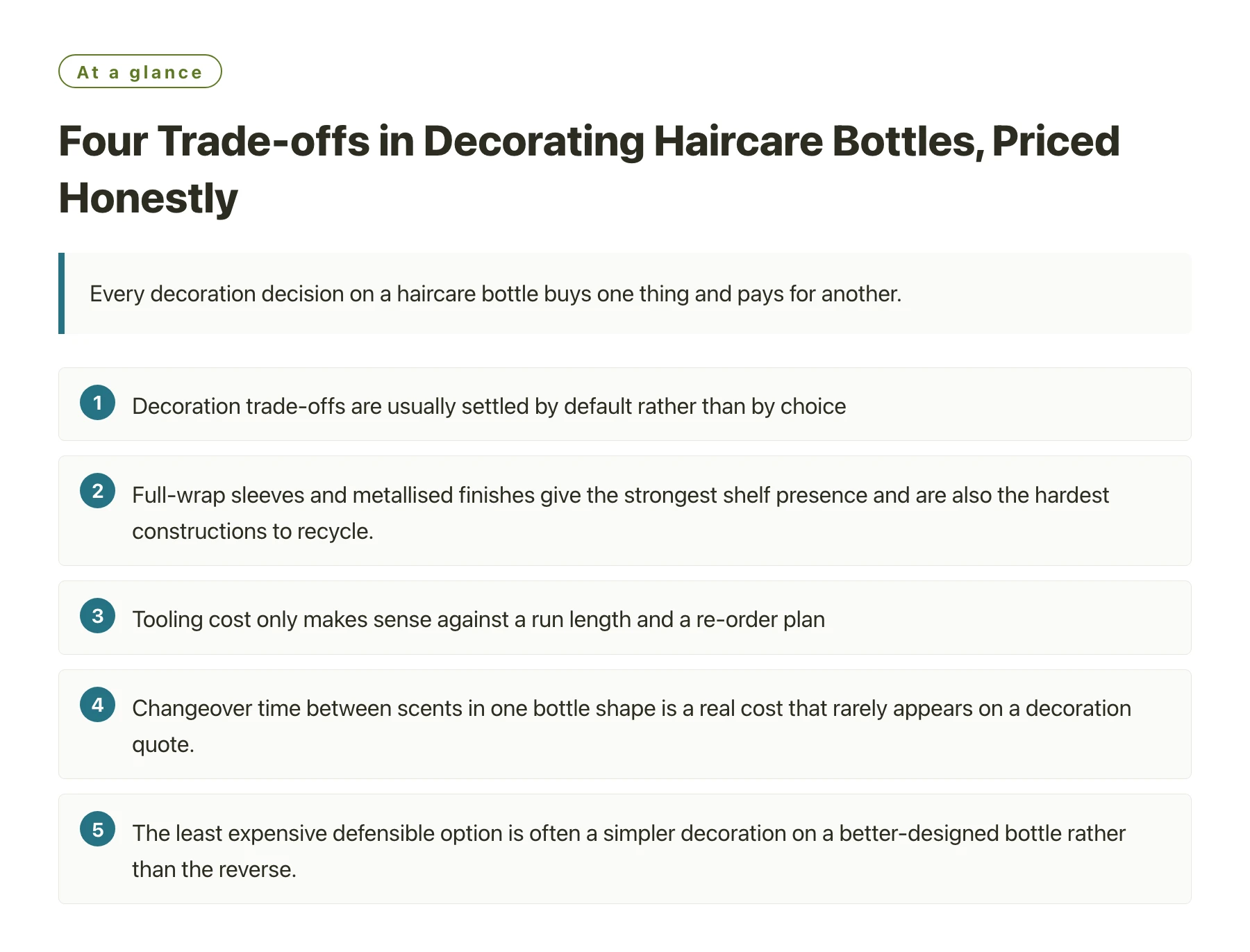
Key takeawaysDecoration trade-offs are usually settled by default rather than by choice, because the artwork is designed before the technique is costed. · Full-wrap sleeves and metallised finishes give the strongest shelf presence and are also the hardest constructions to recycle. · Tooling cost only makes sense against a run length and a re-order plan; tooling bought for a single run rarely pays for itself. · Changeover time between scents in one bottle shape is a real cost that rarely appears on a decoration quote. · The least expensive defensible option is often a simpler decoration on a better-designed bottle rather than the reverse.
Trade-offs become expensive when they are discovered late. A brand that falls in love with a full-wrap metallic design and only then asks about recyclability, tooling and changeover will usually end up choosing between moving the launch and accepting a cost it never budgeted for.
The four trade-offs below are the ones that recur on haircare projects, because haircare combines high volumes, large print areas and multi-SKU ranges in a way that fine fragrance does not.
None of them has a universally right answer. What they all have is a price, and the purpose of this guide is to make that price visible early enough to act on.
The four trade-offs, and what each one costs
| Trade-off | What you gain | What you pay | How to decide |
|---|---|---|---|
| Durability against recyclability | A finish that survives wet handling and looks intact on shelf | Coatings and multi-material sleeves that complicate recycling | Check the packaging expectations of your main market before choosing the finish |
| Colour against tooling | More colours, gradients and photographic effects | Higher tooling cost and less flexibility after the proof | Cost tooling against the run length and the re-order plan, not against one order |
| Technique against run length | A technique matched to the artwork rather than to the equipment | Either a higher unit price or a larger minimum quantity | Ask for unit price at three volumes and find where the curve flattens |
| Speed against changeover | Fewer setups and a shorter total production window | More decorated stock held, and less room to change the range later | Group runs by colour rather than by SKU and decide how much stock you will hold |
The fourth column is where the decision actually gets made. In practice the answer usually depends on one market, one re-order expectation and one warehouse constraint.
Durability against recyclability
Decoration that survives a wet bathroom usually involves a coating, a laminate or a multi-layer sleeve. Those structures are exactly the ones that are hardest to separate in a recycling stream, which is why packaging design guidance tends to favour mono-material constructions and fewer material combinations. The Sustainable Packaging Coalition publishes design guidance aimed at making packaging more recyclable in practice [1].
Regulation is moving in the same direction. European rules on packaging and packaging waste set design, labelling and recyclability expectations for packaging placed on that market, and they have been revised in recent years [2]. For a haircare brand selling into Europe, this is not a future consideration; it belongs in the decoration decision.
The workable compromise is usually to concentrate the decorative effect where it is seen and keep the bottle body as simple as the design allows. A direct print or a partial decoration can deliver a strong shelf impression while leaving most of the pack in a single material, which makes both recycling and any future compliance conversation easier.
Colour against tooling
More colours mean more plates, more stations and more setup, and that cost is largely fixed regardless of how many units you print. A four-colour design on a large haircare bottle can carry a tooling cost that makes sense at a high volume and looks absurd on a trial order.
The right way to read the number is against the whole product life rather than the first purchase order. If the design will run for several seasons, tooling amortises quickly. If the range is likely to be redesigned within a year, the same tooling is expensive regardless of the unit price it enables.
It also helps to know where colour decisions are irreversible. Once a proof is approved and tooling is cut, a change usually means new tooling. Trade coverage of household and personal products manufacturing regularly reports how packaging changes affect production schedules and costs [3], and the pattern is consistent: the later the change, the more it costs.
Technique against run length
Different decoration techniques scale differently. Some are cheap to set up and slower to run, which suits small batches and short runs. Others are expensive to set up and very fast, which suits high volumes and long campaigns. Choosing the technique before understanding the volume curve is how brands end up with the wrong cost structure.
The practical exercise is to ask for the unit price at three volumes, for the same bottle and the same artwork. Plotting those three numbers usually reveals where the technique stops being economic, and where a different one would take over. It also shows whether a lower unit price at a higher volume is really a saving or simply a transfer of risk into inventory.
This is the kind of question a partner that runs development and production under one roof can answer with real numbers rather than estimates, which is one reason brands look at full ODM fragrance service when the range is still being shaped.
Speed against changeover
Running a whole range in one campaign is faster and cheaper per unit, and it leaves a large quantity of decorated bottles to store, protect and account for. Running in smaller waves reduces that inventory, increases the number of setups and normally raises the unit cost.
The variable that changes the calculation most is changeover. A colour change on a decoration line costs setup time and produces a small amount of transitional scrap, and the cost multiplies with every SKU. Sequencing by colour rather than by product often removes changeovers entirely, and asking the decorator to plan the sequence is a better use of their expertise than dictating it.
There is also a market-facing side to this. A wider range launched at once carries more risk if one scent underperforms, while a staged range needs packaging that can be re-run without retooling. Reviewing how other projects have handled the same problem, such as the examples of fragrance projects presented by a manufacturer, is a quick way to see what the sequence looks like in practice.
Decide the trade-offs in this order: market requirements first, then run length, then colour, then speed. Doing it in the reverse order is how a design that cannot be recycled, or a tooling bill that cannot be amortised, gets approved. Xuelei is a useful reference point here, because its published scope covers decoration, filling and packaging inside one programme.
Sources
- Sustainable Packaging Coalition —— A membership organisation working on more sustainable packaging design, publishing material and recyclability guidance.
- European Commission: Packaging Waste and the PPWR —— EU rules on packaging and packaging waste, including the Packaging and Packaging Waste Regulation requirements on recyclability and design.
- HAPPI — Household & Personal Products Industry —— An industry magazine covering the household and personal care market, including fragrance, formulation and packaging.
Frequently asked questions
Is direct printing more recyclable than a shrink sleeve?
Usually, because direct printing adds ink to the bottle rather than a second material that has to be separated. That said, recyclability depends on the whole pack, including the bottle material, the closure and any label, so the decision should be assessed as a system.
How much does decoration tooling cost?
It varies widely with the technique, the number of colours and the size of the print area, which is why a single figure is not meaningful. What matters is comparing the tooling cost against the expected run length and whether the design will be reused.
Should we choose the decoration technique before the artwork?
Choose them together. Artwork designed for one technique often cannot be reproduced economically in another, so approving the design first and costing the technique afterwards is a frequent cause of rework.
How many changeovers should a multi-scent range plan for?
As few as the sequence allows. Ask the decorator to propose a sequence grouped by colour, and ask how many setups it implies. That number, rather than the number of SKUs, is what drives changeover cost.
Does a longer run always lower the unit cost?
It usually lowers the decoration cost per unit, because fixed setup and tooling are spread further. Whether it lowers the total cost depends on storage, financing and the risk of holding stock for a design or scent that may change.
Continue Reading